
Wings and Flight Feathers for Fly Tying
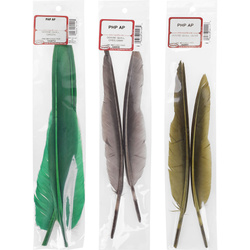
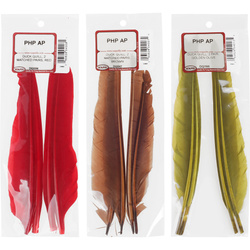
( number of products: 6 )Duck, goose and peacock flight feathers have cohesive vanes and natural curvature from which clean slips can be cut for wet-fly wings, streamers, salmon flies, tails and wing cases. A paired wing requires corresponding sections from left and right feathers.
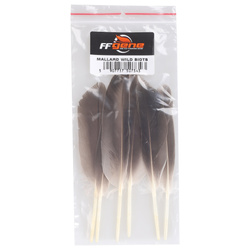
The section includes goose quill, paired duck quills, complete mallard wings, blue-white-tip mallard feathers and mottled peacock flight feathers. Choose the material according to vane structure, curve, marking and required slip width.








Why left and right feathers matter
Flight feathers curve according to the side of the bird. Matching slips from corresponding left and right feathers oppose one another and create a balanced roof, upright or married wing. Two slips cut from one side tend to curve in the same direction and can twist the finished wing.
Goose quill
Goose flight feathers provide broad, cohesive vanes and clean dyed colours. Slips are used in wet-fly and salmon-fly wings, tails, cheeks and body segments. Fibre width changes across the feather, allowing several scales from one quill.
Duck quill and mallard wings
Paired duck quills provide matching curves. Complete mallard wings also offer covert feathers, blue speculum material and several natural markings. Blue-white-tip and related named sections are selected for classical patterns in which the marking itself is important.
Mottled peacock flight feathers
Peacock wing quills carry fine mottling suited to wing slips, legs and shellbacks. They differ from peacock eye and sword feathers. Match the mottling scale and vane strength to the hook.
Cutting paired slips
- Select corresponding areas from left and right feathers.
- Stroke each vane so its barbs are fully joined.
- Measure equal widths before cutting close to the stem.
- Keep the tips and curves aligned.
- Handle the slips by their bases to preserve the vane.
Tying a wing without twisting it
Place the paired slips with their natural curves correctly opposed. Use a controlled pinch or another pattern-specific hold, then bring thread pressure upwards rather than dragging the fibres around the hook. Make the first securing turns before releasing the wing. Excessive pressure can split the vane; insufficient control lets it rotate.
Uses beyond wings
Flight-feather slips form tails, wing cases, shellbacks and segmented bodies. Individual barbs can become legs or antennae. The main stem is usually too thick to wind, but prepared quill sections have separate uses.
Storage
Keep paired feathers together and supported. Avoid folding stems or crushing vanes. When barbs separate without damage, stroking them between fingers often reconnects the barbules. Protect natural feathers from insects and moisture.
Frequently asked questions
Can a paired wing be made from one feather?
It is possible for some folded styles, but a conventional symmetrical paired wing normally needs matching left and right slips.
Is a complete wing better than a pair of quills?
No. A complete wing offers more feather types; selected quills provide predictable matching material for a defined job.
Must a split vane be discarded?
Not always. Undamaged barbs can often be stroked back together. Tears, missing barbs and broken stems cannot be fully repaired.